.png)
NEW RESEARCH PAPER PUBLISHED

April 21, 2026

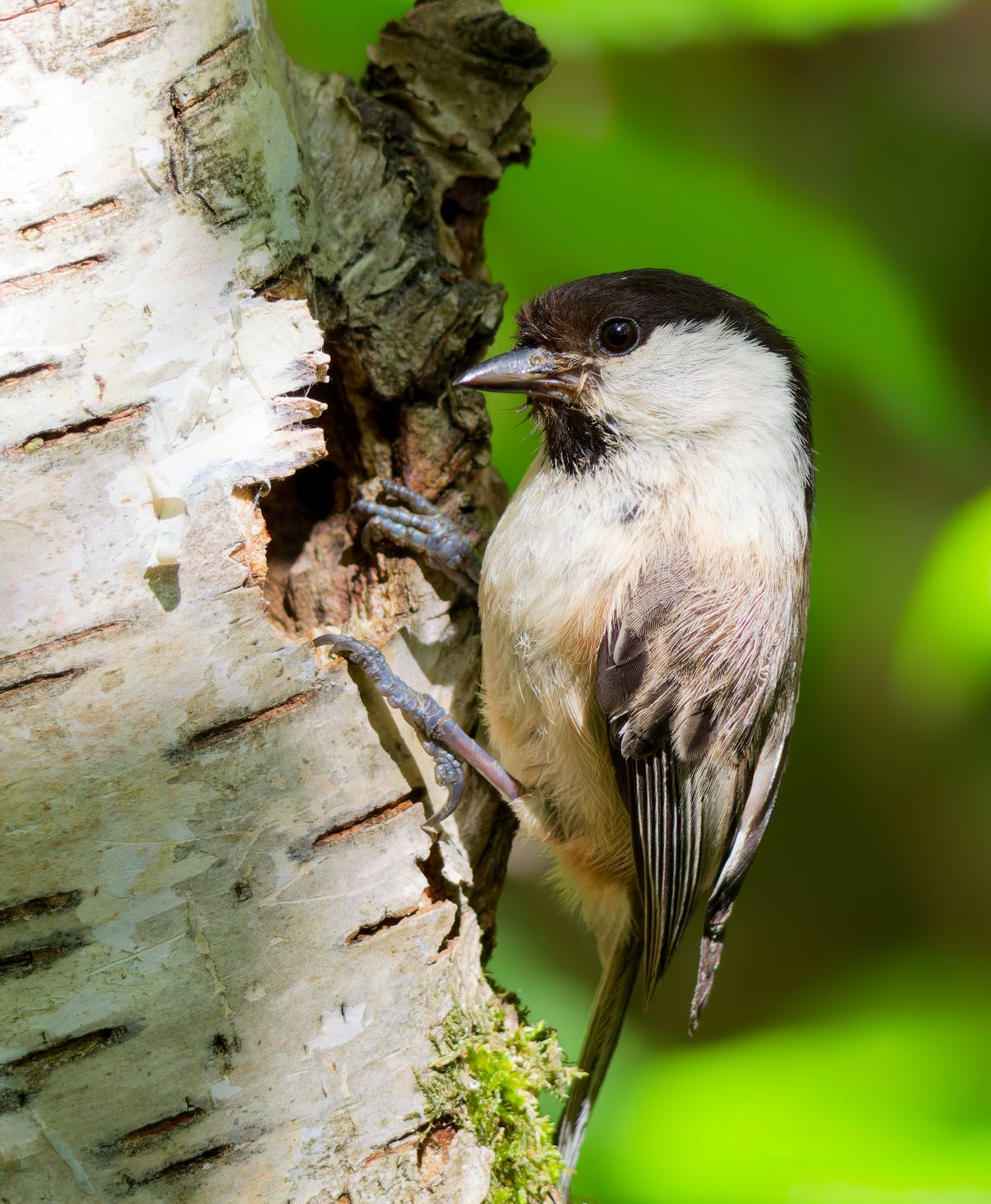
The willow tit has undergone an alarming 97% population decline since the late 1960s, making it the fastest declining resident bird species in the UK, and second fastest declining overall behind the turtle dove. Despite this population crash, the main causes of the decline are still not fully understood.
Severe habitat loss due to intensive forestry has been established as the primary cause of willow tit decline in Northern Europe.1 However, most woodland depletion in Britain took place over 1,000 years ago, and woodland cover has actually increased during the period of the willow tit’s decline,2 so this does not really explain why willow tits are vanishing.
There is some limited evidence of habitat-related effects, with willow tits tending to use wetter and younger woodlands.3,4 As a result, most conservation efforts have focused on maintaining young and wet woodlands through practices such as coppicing and rewetting.5 However, there is no evidence that these interventions have prevented local extinctions, suggesting that habitat management is unlikely to be a limiting factor. 6
Habitat fragmentation is likely to be more of a problem, especially for juveniles leaving the woodlands where they hatched to form new territories. Low occupancy of isolated woodlands has been observed in the closely related marsh tit,7 but there are currently few data for willow tits.8 Earlier research shows that larger areas of woodland in less fragmented landscapes help buffer willow tits against decline.9-11 So habitat-based conservation strategies may be more effective if focussed on low-intervention restoration and rewilding of woodlands to expand existing habitat and improve connectivity between remaining populations.
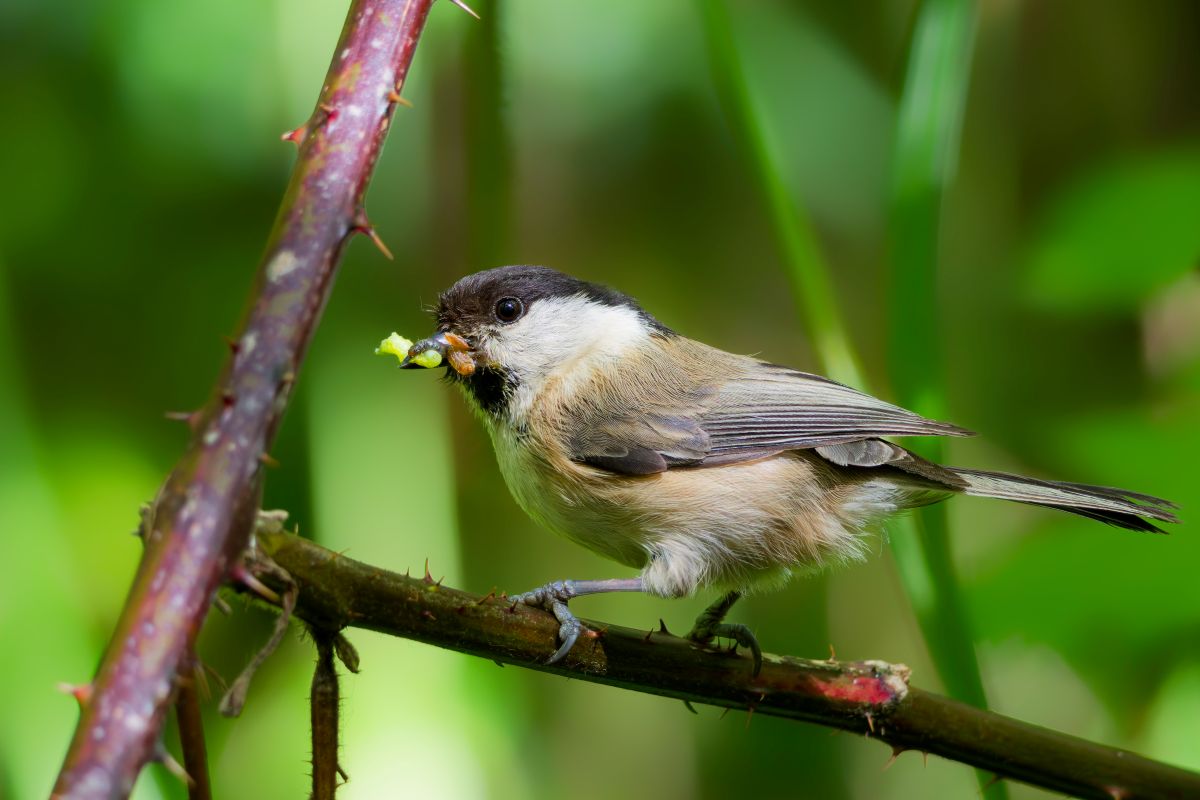
A more likely reason for the population crash is competition and predation. Willow tits suffer the highest rates of nest loss of any tit species in Britain, at least 50% on average. This is double the rate seen in Scandinavia and much higher than other tit species in Britain.12 Much of this is due to eviction from their nest holes by blue tits and, sometimes, great tits,13-16 as well as predation of nestlings by great spotted woodpeckers.15,16
Although blue tits and great tits have declined slightly in the last decade, both species increased by 23% and 67% respectively, during the same period as the willow tit’s decline.17 Even more strikingly, great spotted woodpeckers have increased by a staggering 373%.17 Climate change and widespread garden bird feeding have likely improved winter survival of these species, meaning more competitors and predators survive into the following breeding season.18-21 The widespread use of nest boxes has also provided millions of additional nesting sites for cavity nesting species like blue tits, enabling them to reach higher breeding densities and to occupy formerly unsuitable habitats.22
These factors have probably pushed large numbers of competitor species into habitats where willow tits once remained relatively undisturbed, contributing to the high rates of breeding failures now observed. As a result, pressure on willow tits has increased, reaching a critical point now where even once stable populations in flagship reserves like the Dearne Valley have been lost completely.6,8
The biggest obstacle to saving this species remains the lack of data needed to guide effective conservation, with a fundamental lack of knowledge about their basic ecology and demography. What we need most is well-resourced, long-term research whilst some stable populations still exist, so we can identify which interventions will have the greatest impact in halting this devastating decline before it is too late…
Ben Secker is a Doctoral Researcher at Manchester Metropolitan University studying the willow tit. The project involves a combination of applied field studies of willow tit breeding biology and ecology, as well as behavioural experiments on blue tits. His previous experience includes work on willow tits in the Dearne Valley, as well as an MSc (by research) studying the impact of solar parks on bird diversity and abundance.
1. Lehikoinen, A., Pakanen, V.-M., Kivinen, S., Kumpula, S., Lehto, V., Rytkönen, S., Vatka, E., Virkkala, R. and Orell, M. (2024) ‘Population collapse of a common forest passerine in northern Europe as a consequence of habitat loss and decreased adult survival’, Forest Ecology and Management, 572, p. 122283. Available at: https://doi.org/10.1016/j.foreco.2024.122283.
2. Downey, H. and McHenry, E. (2025) State of the UK’s Woods and Trees 2025. Woodland Trust.
3. Lewis, A.J., Amar, A., CORDI‐PIEC, D. and Thewlis, R.M. (2007) ‘Factors influencing Willow tit Poecile montanus site occupancy: a comparison of abandoned and occupied woods’, Ibis, 149, pp. 205–213.
4. Lewis, A.J., Amar, A., Charman, E.C. and Stewart, F.R. (2009) ‘The decline of the Willow tit in Britain’, British Birds, 102(7), p. 386.
5. Pinder, S. and Carr, G. (2021) Willow tit Conservation Handbook. Back From the Brink. Available at: https://naturebftb.co.uk (Accessed: 15 December 2024).
6. Carr, G., Lunn, J. and Pinder, S. (2024) ‘The Rapid Extinction of Willow tits in a post-industrial landscape.’, British Birds, 117, pp. 195–202.
7. Broughton, R.K., Hill, R.A., Bellamy, P.E. and Hinsley, S.A. (2010) ‘Dispersal, ranging and settling behaviour of Marsh Tits Poecile palustris in a fragmented landscape in lowland England’, Bird Study, 57(4), pp. 458–472. Available at: https://doi.org/10.1080/00063657.2010.489316.
8. Secker, B.M. and Sharp, S.P. (2026) ‘Woodland characteristics associated with the presence of Willow tits Poecile montanus in a fragmented population’, Ringing and Migration [Preprint]. Available at: https://research.lancaster-university.uk/en/publications/woodland-characteristics-associated-with-the-presence-of-willow-t/ (Accessed: 1 June 2026).
9. Hinsley, S.A., Bellamy, P.E. and Newton, I. (1995) ‘Bird Species Turnover and Stochastic Extinction in Woodland Fragments’, Ecography, 18(1), pp. 41–50.
10. Hinsley, S.A., Bellamy, P.E., Newton, I. and Sparks, T.H. (1995) ‘Habitat and Landscape Factors Influencing the Presence of Individual Breeding Bird Species in Woodland Fragments’, Journal of Avian Biology, 26(2), pp. 94–104. Available at: https://doi.org/10.2307/3677057.
11. Broughton, R.K., Hill, R.A. and Hinsley, S.A. (2013) ‘Relationships between patterns of habitat cover and the historical distribution of the Marsh Tit, Willow tit and Lesser Spotted Woodpecker in Britain’, Ecological Informatics, 14, pp. 25–30. Available at: https://doi.org/10.1016/j.ecoinf.2012.11.012.
12. Broughton, R. (2024) The marsh tit and the willow tit. Bloomsbury Publishing.
13. Maxwell, J. (2002) ‘Nest-site competition with blue tits and great tits as a possible cause of declines in willow tit numbers: observations in the Clyde area’, The Glasgow naturalist, 24(1), pp. 47--50.
14. Lewis, A.J., Amar, A., Charman, E.C. and Stewart, F.R. (2009) ‘The decline of the Willow tit in Britain’, British Birds, 102(7), p. 386.
15. Parry, W. and Broughton, R.K. (2018) ‘Nesting behaviour and breeding success of Willow tits Poecile montanus in north-west England’, Ringing & Migration, 33(2), pp. 75–85. Available at: https://doi.org/10.1080/03078698.2018.1631610.
16. Rustell, A. (2020) Willow tits: an illustrated catalogue of nests.
17. BTO (2026) BirdTrends 2025: trends in numbers, breeding success and survival for UK breeding birds.
18. Wilcoxen, T.E., Horn, D.J., Hogan, B.M., Hubble, C.N., Huber, S.J., Flamm, J., Knott, M., Lundstrom, L., Salik, F., Wassenhove, S.J. and Wrobel, E.R. (2015) ‘Effects of bird-feeding activities on the health of wild birds’, Conservation Physiology, 3(1), p. cov058. Available at: https://doi.org/10.1093/conphys/cov058.
19. Plummer, K.E., Bearhop, S., Leech, D.I., Chamberlain, D.E. and Blount, J.D. (2018) ‘Effects of winter food provisioning on the phenotypes of breeding blue tits’, Ecology and Evolution, 8(10), pp. 5059–5068. Available at: https://doi.org/10.1002/ece3.4048.
20. Shutt, J.D. and Lees, A.C. (2021) ‘Killing with kindness: Does widespread generalised provisioning of wildlife help or hinder biodiversity conservation efforts?’, Biological Conservation, 261, p. 109295. Available at: https://doi.org/10.1016/j.biocon.2021.109295.
21. Broughton, R.K., Shutt, J.D. and Lees, A.C. (2022c) ‘Rethinking bird feeding: are we putting extra pressure on some struggling woodland birds?’, British Birds, 115, pp. 2–6.
22. Mänd, R., Leivits, A., Leivits, M. and Rodenhouse, N.L. (2009) ‘Provision of nestboxes raises the breeding density of Great Tits Parus major equally in coniferous and deciduous woodland’, Ibis, 151(3), pp. 487–492. Available at: https://doi.org/10.1111/j.1474-919X.2009.00929.x.
We need your help to fund our crucial independent research and work.
Join our community and receive our exclusive membership benefits.
Receive our monthly e-news and regular updates



.avif)